The Philip Experiment: Can You Create Your Own Ghost?
Toronto, 1972 — eight ordinary people invented a ghost, and then something started answering.
Published 9/20/2026 · Last revised 9/20/2026
Researched and written by Jamie Stas, independent researcher and author · Last reviewed 20 September 2026
In 1972 the Toronto Society for Psychical Research set out to manufacture a ghost from nothing but imagination. Within a year the table was rapping answers, the lights were flickering on cue, and the group could no longer agree on who — or what — was in the room.
Introduction
Most hauntings begin with a claim: something is here. The Philip Experiment began with the opposite premise — nothing is here, and we are going to build it anyway.
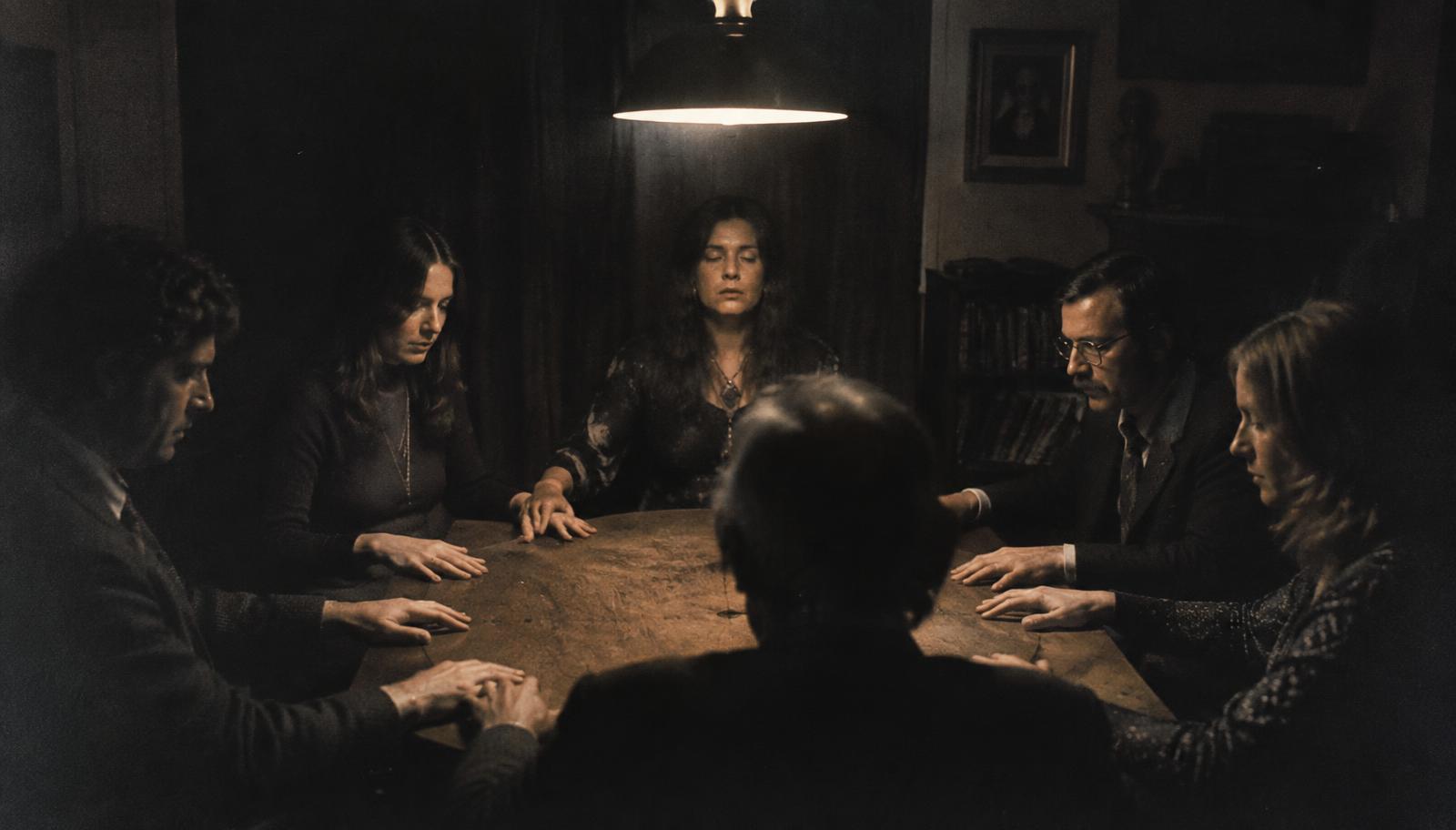
A group of eight volunteers, led by mathematician and psychical researcher Dr. A.R.G. Owen and coordinated by his wife Iris Owen, invented a fictional seventeenth-century English aristocrat named Philip Aylesford. They gave him a biography, a doomed love affair, a suicide. They were explicit that he had never existed. Then they sat around a card table and waited.
Origins: A Deliberate Fiction
The Toronto Society for Psychical Research (TSPR) was not a group of thrill-seekers. Dr. A.R.G. Owen was a Cambridge-trained mathematician and geneticist; the membership included an industrial designer, an accountant, a housewife, a bookkeeper, and a sociology student. Their hypothesis, drawn from earlier work by British psychologist Kenneth Batcheldor, was blunt:
Poltergeist phenomena are not produced by the dead. They are produced, unconsciously, by the living — and belief is the switch.
To test this, the group needed a subject that could not possibly be a real spirit. So they wrote one.
The Biography of Philip Aylesford
| Detail | Invented fact |
|---|---|
| Born | 1624, England |
| Station | Aristocrat, supporter of the Royalist cause |
| Wife | Dorothea, cold and unloving |
| Lover | Margo, a Romani girl accused of witchcraft |
| Death | Suicide in 1654, after failing to save Margo from burning |
| Residence | "Diddington Manor" — a real building, but with no Philip in its records |
Every detail was checked against history to make sure it was wrong. The group even commissioned a sketch of Philip so they would share a common mental image.
Phase One: A Year of Nothing
For roughly twelve months the group meditated. They sat in a room decorated to evoke the seventeenth century, discussed Philip's life, and tried to visualise him. Reports describe occasional feelings of presence, but nothing measurable. No raps. No movement.
This failure matters. It is the control period that later critics rarely quote.
Phase Two: The Batcheldor Switch
In 1973 the group changed its method on Batcheldor's model. Out went solemn meditation; in came singing, joking, ghost stories, and dim red lighting. The mood shifted from laboratory to party.
Within weeks, the table began to rap.
One rap for yes. Two raps for no.
The answers were consistent with Philip's invented biography — and, crucially, only with it. Asked questions outside the fiction, the table hedged, contradicted itself, or fell silent. When a sitter privately believed something false about Philip, the table sometimes produced that false answer.
Reported Phenomena
- Sharp, percussive raps from the tabletop, audible across the room
- The table sliding, tilting, and on several occasions "walking" toward latecomers
- The table reportedly climbing stairs during a 1974 filming session
- Cool breezes localised over the table surface
- Lights dimming and brightening in apparent response to requests
- A recorded session for Canadian television in front of a live studio audience1
Phase Three: Going Public
In 1974 the group performed for a television audience of roughly fifty people. The table rapped on request and moved across the studio floor with the sitters' hands resting lightly on top. The footage survives and remains the most-cited primary artefact of the experiment.
Two follow-up groups were run by TSPR — "Lilith," a French-Canadian spy, and a fictional man named "Sebastian" — reportedly reproducing raps more quickly than Philip's group had.
The Skeptical Case
A fair reading has to take the prosaic explanations seriously.
- The ideomotor effect. Sitters resting hands on a table produce unconscious micro-pressures. Under expectation and social contagion these can tilt, slide, and knock a lightweight table.
- No blind controls. Sitters knew the questions and Philip's biography. There was no protocol in which the group was ignorant of the expected answer.
- No instrumentation. No strain gauges, no force plates, no infrared. The evidence is film, audio, and testimony.
- Deliberate permissiveness. Batcheldor's method explicitly encouraged "artifact" — allowing minor cheating to build belief. This is methodologically fatal for proving a force.
- Absence of replication under controls. No controlled laboratory replication with disinterested observers has reproduced the reported table locomotion.
What Survives Scrutiny
Strip away the contested claims and a smaller, stranger residue remains.
- The group produced no phenomena at all during the year of sincere, earnest meditation.
- Phenomena appeared only after the group adopted relaxed, disinhibiting, belief-friendly conditions.
- The "personality" that emerged was bounded by the fiction the group wrote — it did not know things the group did not know.
- Nobody in the group reported consciously producing the raps, and several were disturbed by them.
That pattern — phenomena tracking group psychology rather than any external entity — is the experiment's actual finding, and it is the same pattern reported in a century of poltergeist case files.
[1] The 1974 Toronto broadcast footage is the principal surviving audiovisual record; several later copies circulate with degraded audio.
The unexplained core
What remains after every prosaic explanation we could test.
Verified: The experiment happened, was documented by TSPR, and was filmed before a live audience in 1974. The group's year of null results before switching methods is on record.
Unverified but consistently reported: Table locomotion without proportionate hand pressure, including movement up a staircase; localised cold; light response.
Speculative: That the phenomena were paranormal in origin. No controlled replication exists, and the method explicitly permitted unconscious and even minor deliberate assistance.
The residue: Why nothing at all happened during twelve months of sincere effort, and why phenomena began within weeks of the group deciding to stop taking it seriously.
Conclusion
The Philip Experiment did not prove ghosts exist. It may have proved something more uncomfortable: that a group of ordinary people, under the right social conditions, can generate an apparently autonomous personality with a voice, a temper, and a will — and can become genuinely unsure whether they are the authors of it.
Whether the raps came from unconscious muscles or from something that has no name yet, the group built a haunting out of nothing but agreement. Every field investigator who has walked into a house where a family is certain something is there should find that deeply relevant.
Linked case records
Individual incidents inside this investigation. Expand a record for witnesses, evidence types and the competing explanations.
Sources & citations
- [1]Primary
Conjuring Up Philip: An Adventure in Psychokinesis
Iris M. Owen with Margaret Sparrow · Harper & Row · 1976
"We had created Philip, and Philip was now, in some sense, creating us."
Primary account of the experiment and its protocol.
- [2]Primary
Report on a Case of Table Levitation and Associated Phenomena
Kenneth J. Batcheldor · Journal of the Society for Psychical Research · 1966
"Belief is not a by-product of the phenomena; it is a precondition of them."
Source of the disinhibition method adopted in 1973.
Open source - [3]Archival
Toronto Society for Psychical Research session records, 1972–1975
TSPR · 1975
Session-level detail; treat dating with caution.
- [4]Secondary
The Ideomotor Effect and Ostensible Table-Turning
Ray Hyman · Skeptical Inquirer · 1999
"The sitters are the engine; the table is only the dial."
Principal prosaic counter-explanation.
Case updates
9/20/2026
Dossier published
Deep dive, two incident records and four sources published after review.
9/20/2026
Archival request filed
Request submitted for complete TSPR sitting notes covering 1972–1973.
Related investigations
Matched on shared phenomena and filing tags.
Stargate: Twenty Years of Government Remote Viewing
What the declassified files actually say — and what they carefully avoid saying
Jaytee: The Dog Who Knew When His Owner Was Coming Home
A decade of videotape, two research teams, and one very patient terrier
Peak in Darien: Deathbed Visions of People Not Known to Be Dead
The one class of end-of-life vision that expectation cannot easily explain
Community discourse
Moderated discussion. Contributions are held to the same evidence standards as the dossier itself: claims need a source, and speculation should be labelled as such.
Open the full community indexCommunity discussion
No approved threads on this dossier yet.