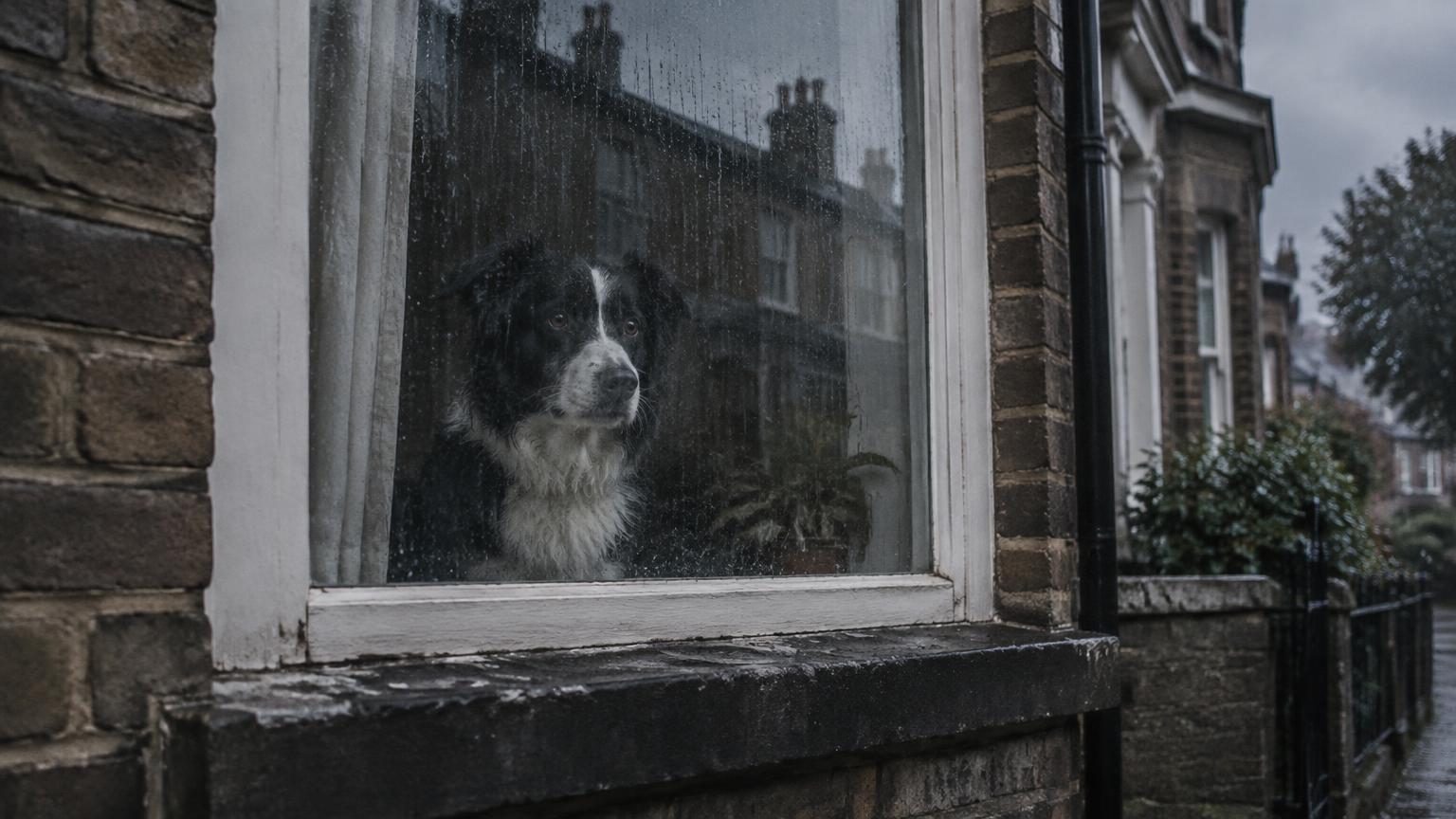
Jaytee: The Dog Who Knew When His Owner Was Coming Home
A decade of videotape, two research teams, and one very patient terrier
Published 8/25/2026 · Last revised 9/20/2026
Documentary not published yet
Awaiting YouTube release
Researched and written by Jamie Stas, independent researcher and author · Last reviewed 20 September 2026
Between 1994 and 1999 a terrier in Ramsbottom, England, was filmed hundreds of times waiting at a window before his owner began her journey home. Two research groups analysed the same dog and reached opposite conclusions. The tapes still exist.
Introduction
Pam Smart adopted Jaytee from a rescue centre in 1989. Her parents noticed that the dog would move to the bay window and sit there shortly before Pam returned — even when she came home at irregular hours, by different transport, and without telephoning ahead. In 1994 the biologist Rupert Sheldrake began filming the window continuously. What followed is one of the most heavily documented, and most bitterly disputed, datasets in parapsychology.
Why this case is unusual
Most animal-anticipation claims die at the anecdote stage. Jaytee did not, for one reason: there is continuous videotape, time-coded, of the window area during the owner's entire absence. That converts a story into a measurable signal.
Between May 1994 and February 1995 Pam Smart's parents logged Jaytee's behaviour on 100 occasions. Sheldrake then ran 30 videotaped experiments where Pam's return time was chosen at random by the experimenter and communicated to her by pager, after she had already left the house.
The measure
The dependent variable was the proportion of each period that Jaytee spent at the window, excluding periods explainable by ordinary causes (a passing cat, a delivery van). Sheldrake divided each absence into:
- the main period (Pam away, no return underway)
- the pre-return period (roughly the ten minutes before Pam set off)
- the return journey itself
In the randomised-return trials, Jaytee spent an average of 4 percent of the main period at the window, 55 percent of the pre-return period, and 23 percent of the return journey.
The pattern was consistent across seasons, distances from three to fifty kilometres, and different vehicles.
The counter-analysis
Richard Wiseman, Matthew Smith and Julie Milton ran four of their own trials in 1995 and reported a negative result. Their criterion was different: they scored the first signal — the first time Jaytee went to the window for more than two minutes — and found it occurred early in the absence, long before Pam set off.
Sheldrake replied that Jaytee visited the window frequently and briefly for ordinary reasons, so a "first signal" rule guarantees an early hit and discards the shape of the whole curve. When Wiseman's own four tapes were re-plotted using the proportion-of-time measure, they produced the same rising curve as Sheldrake's thirty.
::: callout Both teams agree on the raw footage. The dispute is entirely about which statistic is the legitimate measure of anticipation — a methodological argument, not an argument about whether the dog moved. :::
Prosaic explanations that have been tested
- Routine. Ruled out by randomised, experimenter-chosen return times.
- Hearing the car. Jaytee reacted while Pam was still kilometres away and travelling in unfamiliar vehicles.
- Smell. No plausible mechanism at the distances and wind conditions recorded.
- Cueing by the people at home. Pam's parents did not know the return time; they were also filmed.
- Selective reporting. The continuous tape means non-events are on the record too.
What remains open
No one has replicated the effect at scale with other animals under the same filming protocol. A single dog, however well documented, is a single dog.
The unexplained core
What remains after every prosaic explanation we could test.
Under randomised return times unknown to anyone at the house, the dog's window-waiting rose from roughly 4 percent to over 50 percent of the time in the minutes surrounding his owner's decision to head home. Every conventional cue tested so far fails to account for the timing. What is NOT established is any mechanism, or that the effect generalises beyond this animal.
Conclusion
The Jaytee tapes are a rare thing: a paranormal claim that survived contact with a control condition, and then stalled — not because it was debunked, but because the field never funded the replication that would settle it. Twenty-five years later the correct verdict is still "unresolved and under-tested", which is a far more uncomfortable answer than either side wants.
Linked case records
Individual incidents inside this investigation. Expand a record for witnesses, evidence types and the competing explanations.
Sources & citations
- [1]Primary
A Dog That Seems To Know When His Owner Is Coming Home
Rupert Sheldrake and Pamela Smart · Journal of Scientific Exploration · 2000
Jaytee was at the window 4 percent of the time during the main period and 55 percent during the pre-return period.
Primary dataset and protocol.
Open source - [2]Primary
Can Animals Detect When Their Owners Are Returning Home?
Richard Wiseman, Matthew Smith and Julie Milton · British Journal of Psychology · 1998
The dog failed to show any evidence of an ability to anticipate his owner's return.
The competing analysis.
Open source
Case updates
9/20/2026
Original videotapes confirmed archived
All 30 randomised-return tapes are confirmed to survive in the researcher archive. We have requested access for independent re-scoring.
Related investigations
Matched on shared phenomena and filing tags.

Stargate: Twenty Years of Government Remote Viewing
What the declassified files actually say — and what they carefully avoid saying
The Philip Experiment: Can You Create Your Own Ghost?
Toronto, 1972 — eight ordinary people invented a ghost, and then something started answering.
Premonition
Community discourse
Moderated discussion. Contributions are held to the same evidence standards as the dossier itself: claims need a source, and speculation should be labelled as such.
Open the full community indexCommunity discussion
No approved threads on this dossier yet.