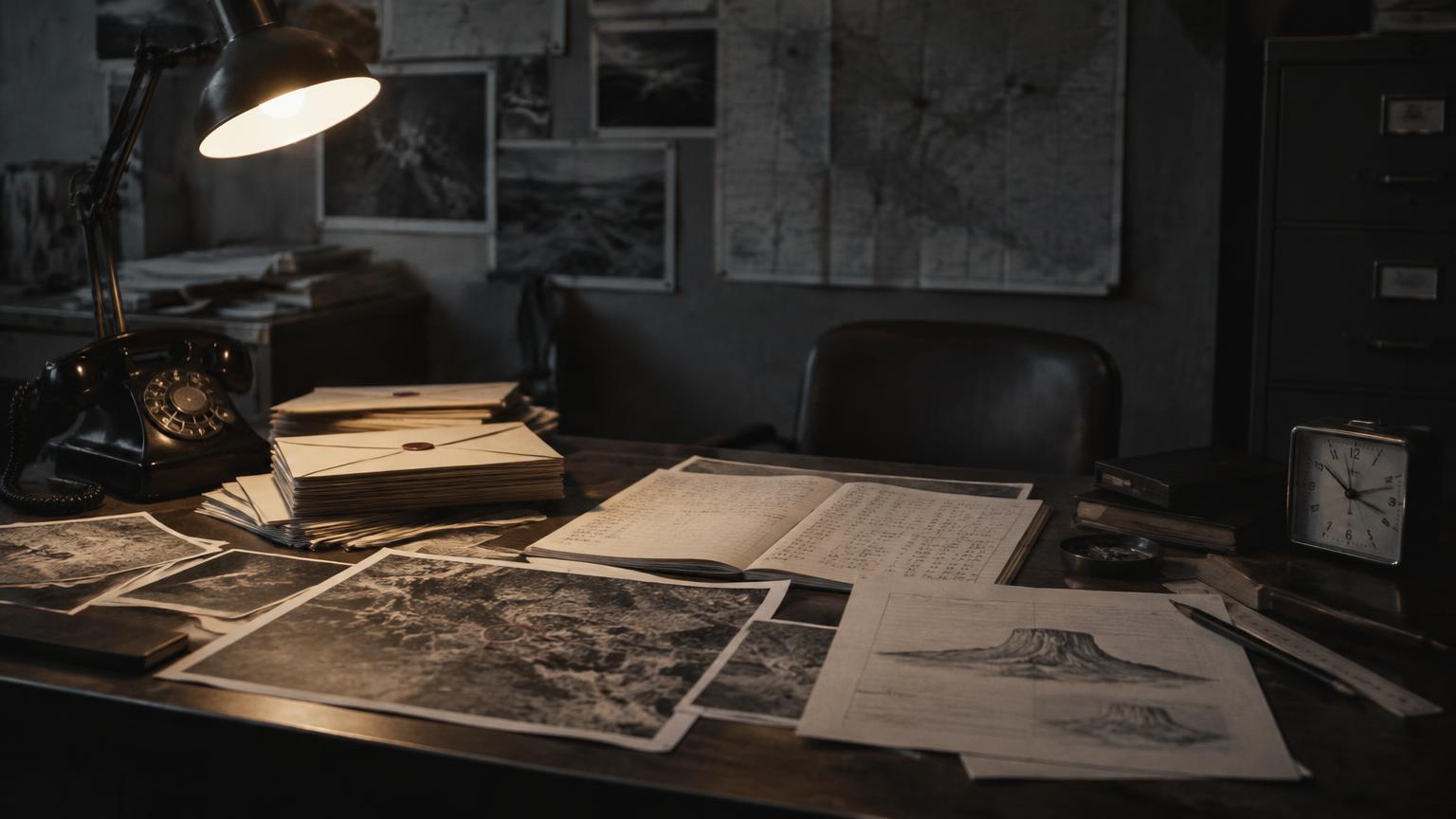
Stargate: Twenty Years of Government Remote Viewing
What the declassified files actually say — and what they carefully avoid saying
Published 9/11/2026 · Last revised 9/22/2026
Researched and written by Jamie Stas, independent researcher and author · Last reviewed 22 September 2026
From 1972 to 1995 the US government funded research into remote viewing at SRI International and later at Fort Meade. The programme was declassified in 1995 alongside two contradictory evaluations by the same review panel.
Introduction
The popular version is that "the CIA proved psychic spying works" or, alternatively, that "the CIA proved it was all nonsense". Both claims cite the same document: the 1995 American Institutes for Research evaluation. Reading the primary files is a lesson in how a single dataset supports two irreconcilable summaries.
The programme in outline
- 1972–1986, SRI International. Physicists Harold Puthoff and Russell Targ run laboratory trials, initially with Ingo Swann and Pat Price. Funding from CIA, later DIA and Army.
- 1986–1995, Fort Meade. Operational unit, at times fewer than six viewers, tasking from multiple agencies.
- 1995. Programme transferred to CIA, evaluated by the American Institutes for Research, terminated and declassified.
The AIR evaluation, in its own words
Two reviewers were commissioned. Jessica Utts, a statistician, concluded that the laboratory effect size was consistent and statistically robust across replications. Ray Hyman, a psychologist, agreed the statistics were not the result of obvious error but argued that a methodological flaw not yet identified remained more likely than a novel channel of information.
Utts: the effect is "far beyond what is expected by chance." Hyman: "the case for psychic functioning seems better than it ever has been" — while still concluding the evidence was insufficient.
The programme was closed on the operational finding that the intelligence produced was too vague to be actionable, which is a different judgement from "the effect does not exist".
The best-documented operational episodes
Files describe viewers producing correct structural descriptions of targets they had no conventional access to, alongside a large volume of descriptions that were wrong, generic, or unverifiable. The declassified record does not contain a clean, pre-registered operational success.
Where the methodology is genuinely weak
- Judging. Matching a sketch to a target site involves human judgement; blind judging was used but panel selection varied.
- Target pools. Early SRI target sets were criticised by David Marks for potential cueing through transcript ordering.
- Selection of reported cases. Operational anecdotes circulated publicly were chosen after the fact.
- Sensory leakage. Rarely fully excluded in the earliest trials; tightened later.
::: callout The honest summary: a twenty-year, tens-of-millions-of-dollars effort produced a laboratory statistical anomaly that two competent reviewers could not dismiss, and an operational record too noisy to use. Neither "proven" nor "debunked" fits. :::
The unexplained core
What remains after every prosaic explanation we could test.
Two independent reviewers commissioned by the US government agreed that the laboratory remote-viewing database showed a statistical departure from chance that could not be attributed to any identified error. They disagreed on whether an unidentified flaw or a real anomaly was the better explanation. The operational intelligence value was assessed as negligible. No declassified document establishes a verified operational remote-viewing success.
Conclusion
Stargate is the most expensive negative-but-not-quite-negative result in the history of anomalous cognition research. The documents reward reading precisely because they refuse to deliver the headline either camp wants.
Linked case records
Individual incidents inside this investigation. Expand a record for witnesses, evidence types and the competing explanations.
Sources & citations
- [1]Primary
An Assessment of the Evidence for Psychic Functioning
Jessica Utts · Journal of Scientific Exploration · 1996
Using the standards applied to any other area of science, it is concluded that psychic functioning has been well established.
Reviewer one.
Open source - [2]Primary
Evaluation of Program on Anomalous Mental Phenomena
Ray Hyman · Journal of Parapsychology · 1996
The case for psychic functioning seems better than it ever has been. Yet I do not believe that it is yet strong enough.
Reviewer two.
Open source
Case updates
9/20/2026
Additional file tranche reviewed
A further batch of declassified operational tasking summaries has been read; nothing in it changes the conclusions above. The dossier status is set to updated.
Related investigations
Matched on shared phenomena and filing tags.
The Philip Experiment: Can You Create Your Own Ghost?
Toronto, 1972 — eight ordinary people invented a ghost, and then something started answering.
Jaytee: The Dog Who Knew When His Owner Was Coming Home
A decade of videotape, two research teams, and one very patient terrier
Terminal Lucidity: When the Mind Returns at the End
Patients with destroyed brain tissue who speak clearly hours before death
Community discourse
Moderated discussion. Contributions are held to the same evidence standards as the dossier itself: claims need a source, and speculation should be labelled as such.
Open the full community indexCommunity discussion
No approved threads on this dossier yet.