How a Haunting Could Work
Published 10/31/2026 · Last revised 10/31/2026
Researched and written by Jamie Stas, independent researcher and author · Last reviewed 31 October 2026
An in-depth investigation of haunting mechanisms, from perception and surviving consciousness to residual information, poltergeist effects and haunted objects.
How a Haunting Could Work
AreGhostsReal — Research deep dive. Prepared 2 October 2026.
A haunting becomes much more interesting when we ask what it does. Does it repeat a route? Recognise a visitor? Follow someone into another building? Produce information? Make a sound that a microphone records? Move an object that several people can see?
Those questions lead beyond the familiar image of a dead person wandering through an old house. They ask what kind of process could connect consciousness, a location and a physical event.
The working position of this investigation is that some hauntings are genuine anomalous events. We therefore investigate possible mechanisms, including surviving consciousness, information associated with a place or object, and effects involving living people. This is an investigative position, rather than a claim that a particular paranormal mechanism has been experimentally established. The case material, experimental results and proposed explanations are identified separately throughout.
1. A haunting may contain several different processes
The word haunting can conceal an important problem: it groups together events that might have very different causes.
Seeing a figure involves perception. Learning a fact involves information. A vase accelerating across a room involves physical force. The identification of the figure as a particular deceased person introduces a fourth problem: identity.
A useful investigation separates these questions before trying to connect them.
| Reported behaviour | What a mechanism must explain | Most useful distinction |
|---|---|---|
| The same figure follows the same route | Persistence and repeated access to a pattern | Repetition versus adaptation |
| A presence reacts to a new question | Acquisition and processing of current information | Apparent responsiveness versus demonstrated responsiveness |
| A witness receives an unknown, accurate detail | Access to information beyond ordinary knowledge | Accuracy, specificity and possible information leakage |
| Objects move or impacts occur | Force, energy transfer and the physical origin of the event | Witnessed occurrence versus recorded onset |
| Activity appears around one person in several buildings | A relationship with that person | Person dependence versus location dependence |
| Activity accompanies an object through different owners | A relationship with that object | Actual object presence versus belief about its presence |
These categories can overlap. A putative surviving consciousness might affect a witness's perception without moving matter. A living person might be involved in anomalous physical effects without consciously intending them. A repeated apparition might also contain moments of apparent recognition.
The aim is therefore to describe the event closely enough that an explanation can fail. A theory that can explain any possible outcome has little practical value.
2. What the historical cases actually contribute
Historical reports are valuable because they preserve proposed patterns and, sometimes, attempts to investigate them. They are not interchangeable with continuously monitored experiments. The following examples help define the mechanistic questions; they do not all carry the same evidential weight.
The Morton or Cheltenham case: repetition with an uncertain interface
Morton's 1892 report describes a recurring woman in black and cords across her route that reportedly remained intact. Myers collected witness testimony and referred to earlier correspondence. Identification was tentative, involving a photograph of the supposed woman's sister. The source provides testimony, including some earlier records, rather than an instrumentally captured apparition. [1]
The question this raises is whether a repeating appearance would be a physical object, a perception of stored information, or an encounter shaped by an observer. Repetition alone cannot decide between those possibilities. A conscious person also has routines.
Rosenheim: the difference between an instrument reading and its cause
Karger and Zicha's 1968 physical report describes investigating disturbances in a lawyer's office, using a storage oscilloscope to examine explanations for recorder deflections. They interpreted the effects as mechanically induced rather than electrodynamic. That was their conclusion about the observed apparatus, not the identification of a ghostly energy source. [2]
Bender's separate account associated activity with a young employee and acknowledged the institute could not maintain a permanent observer at the office. This makes both person dependence and incomplete surveillance relevant to interpreting the case. [3]
Two lessons follow. First, an event registered by an electrical instrument need not have originated as an electrical signal. Second, activity associated with an individual could reflect a living source, an external agent linked to that person, ordinary interference, or a mixture. The association does not by itself choose the explanation.
Enfield: reported force and disagreement within the investigation
The SPR's account reproduces policewoman Caroline Heeps's statement describing a chair wobbling and then sliding approximately three to four feet. The archive also contains critical assessments of the investigation. This is a specific witness report with a stated distance, rather than a controlled measurement of a chair's complete trajectory. [4]
Anita Gregory, who visited the household, challenged the investigators' methods and considered the children capable of misleading them. Her objections belong in the assessment of Enfield; presenting it as unanimously endorsed by SPR investigators would be inaccurate. [5]
For mechanism research, a physical event must be evaluated separately from claims about a voice or a deceased identity. Even a genuine unexplained movement would not establish who caused it.
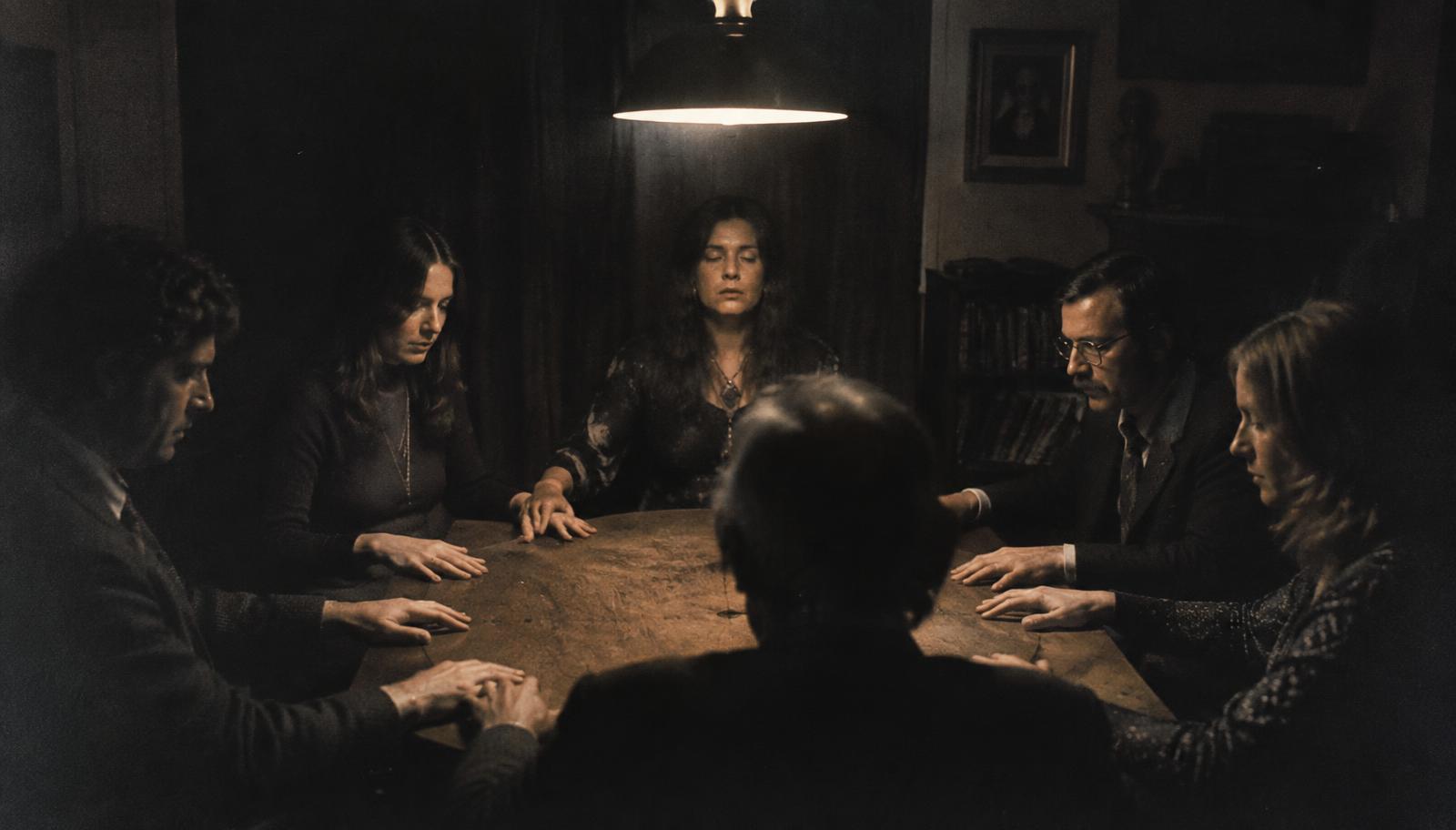
Philip: a personality supplied before the alleged effects
Owen and Sparrow's original report describes eight sitters inventing a fictional communicator. Initial meditation produced no apparition. After a change of approach, they reported raps and table movements associated with the character. Their early report explicitly says there had not yet been clear levitation. Hands remained involved in the sittings, so movements cannot be treated as controlled demonstrations of contactless force. [6]
The mechanistic question is nevertheless striking: if anomalous effects occurred, would the personality expressed through them necessarily identify their source? A supplied character could organise an experience or a group process. The identity expressed by a phenomenon and the cause of that phenomenon are separate questions.
How these cases should be used together
They illustrate different problems, not four replications of one result. Morton emphasises appearance and recurrence. Rosenheim adds technical investigation and a person association. Enfield adds disputed testimony about movement. Philip adds a deliberately invented personality.
Their combined value is conceptual: they show why a single explanation needs several distinct components. Their weaknesses do not disappear when the reports are placed next to one another.
A useful comparison: six modern apparition investigations
Stevenson's 1995 paper investigated six experiences, including death-coinciding appearances and figures associated with dying people. He reported obtaining corroboration before verification in only one case. Such acute encounters are a comparison group for apparition mechanisms, rather than evidence of recurring location-based activity. Their value here is the emphasis on whether an account was independently preserved before the witness learned the corresponding facts. [19]
A useful haunting study would apply that timing discipline to each new event, instead of relying on a later reconstruction of what people remember knowing.
3. Mechanism one: an experience built from external information
A person can experience a figure as standing in a doorway without there necessarily being a human-shaped body in the doorway. This opens a serious paranormal possibility: the origin of information could be external while the experienced image is constructed through the witness's perceptual system.
G. N. M. Tyrrell developed a telepathic interpretation of apparitions in Apparitions. H. H. Price's preface describes a theme or motif becoming a detailed perceptual scene through processes outside conscious awareness. The theory also proposed participation by more than one mind in collective experiences. It was a theory about the construction of appearances, not a demonstrated communication channel. [7]
The modern version explored here would work in three stages:
- An information source becomes accessible to a person.
- The person's perceptual system gives that information a sensory form.
- The sensory form is experienced within the person's current surroundings.
That source could be a living person, a surviving consciousness, or a proposed record of the past. The model does not settle its own source.
This approach has a useful consequence for the familiar question of clothing. If an apparition is an informational presentation of a person, a coat is part of the presentation. The hypothesis does not require the coat itself to have survived death. This is an explanatory advantage of the model, not evidence that the model is correct.
It also makes differing witness descriptions relevant. Two people might agree on the identity or position of an apparent figure while supplying different peripheral details. Alternatively, precise agreement on previously unknown details could indicate a more constrained shared source. Neither pattern should be assumed in advance.
What perception research genuinely establishes
Blanke and colleagues studied neurological patients and used robotic sensorimotor conflicts to induce a feeling of another presence in healthy participants. Their work demonstrates a bodily and neural route to that particular experience. It did not reproduce verified unknown information, an identified dead person, or unexplained movement of furniture. [8]
The paranormal extension remains a hypothesis: an external influence might engage some of the same perceptual machinery. The experiment establishes that machinery can generate a presence experience; it does not establish an external paranormal input to it.
A camera test could therefore be informative. An externally visible manifestation should interact with the light reaching cameras. An influence on perception need not appear in an ordinary image. Failure to capture an apparition is consistent with a perceptual model, but also with misperception; it cannot be used as a free-standing proof of the perceptual paranormal explanation.
The decisive addition would be information. A presence that supplies accurate, specific material unavailable to the witness presents a different research problem from a vivid presence alone.
4. Mechanism two: a surviving consciousness uses a connection
Under the survival hypothesis, the source is a continuing individual who can remember, perceive, choose and communicate. A haunting would then be an intermittent interaction involving that individual, rather than merely a replay of an event.
The hypothesis needs at least four functions:
| Required function | What it would enable | Question that remains |
|---|---|---|
| Persistence | Continued memory and personality | What maintains their organisation after bodily death? |
| Access | Awareness of current people or events | How does information about the present become available? |
| Selection | Contact with a particular person, place or object | What establishes and maintains that relationship? |
| Expression | An experience or physical event in the living world | What interaction produces the observable effect? |
Calling the source a spirit does not remove any of these requirements. It identifies a possible agent and leaves its capacities to be investigated.
Attachment could be a relationship rather than confinement
A location might matter because of memory, repeated attention, emotional significance or an ongoing relationship. This is a proposed explanation for localisation. It need not involve a consciousness being physically trapped between four walls.
Consider an explicitly hypothetical example: a deceased person retains a strong connection with a living relative and with the kitchen in which they spent time together. Contact occurs when the relative enters that room. The effective connection involves person and place together. Moving house might disrupt it, transfer it, or leave a second route of access through an object.
This model predicts selective activity rather than uniform exposure. If correct, particular people or circumstances could matter more than the building's age. That prediction would need to be specified before inspecting a case.
Intelligence is easier to claim than identity
A noise after a question may feel like an answer. A useful intelligence test requires a response that depends on something new. A stronger identity test adds information specific to the purported individual.
Ian Stevenson argued that certain apparition reports favour survival, drawing attention to purpose, collective experiences and the apparent agent's contribution. He also described the historical evidence as limited and difficult to authenticate. His discussion is an argument about interpretation, not a measurement of the mechanism by which a deceased consciousness acts. [9]
Blinded mediumship research provides an adjacent line of inquiry. Beischel and Schwartz's 2007 study used eight selected mediums and eight sitters, with blinded proxy readings and transcript ratings. Intended readings received higher ratings than paired controls. The authors explicitly said their result could not distinguish survival from alternative paranormal information-access hypotheses. The small selected sample and human ratings are material to interpretation. [10]
This result is relevant to the possibility of anomalous information acquisition. It is not a demonstration of a haunting. Even accepting the information as anomalous would leave the source unresolved.
For a haunting, useful identity evidence would include an unusual detail recorded before verification, a private relationship expressed accurately, and a consistent purpose maintained through unexpected questions. Any such tests must also include wrong statements and failed answers. A compelling correct detail loses meaning if selected from many unreported guesses.
5. Mechanism three: information persists and can be accessed later
The residual-haunting hypothesis proposes that something about a past event remains available without requiring the original person to be actively involved. The popular Stone Tape idea imagines an environment recording an event and occasionally replaying it.
That image contains several separable possibilities. A material record might exist in a building. A location might be a route to information stored elsewhere. Alternatively, the observer could access a past event directly. These proposals need different evidence.
A literal recording needs a recorder, a record and a reader
For an actual wall to preserve a complex event, a theory must say which physical properties change, how those changes encode the event, how they remain stable, and how they later produce a recognisable experience.
A person's grief is not itself a storage medium. Repetition is not proof of a recording. Materials can carry physical traces of events, but the existence of a trace does not establish that it contains a person's voice, intentions or visible form in recoverable detail.
An adequate proposal would therefore have to identify:
- The substrate: a material structure or other defined carrier.
- The encoding: the relationship between the original event and the stored pattern.
- The lifetime: how long that pattern survives interference and change.
- The trigger: why access happens on one occasion and not another.
- The reader: what converts the pattern into a sensory or physical event.
Without these components, Stone Tape remains a suggestive analogy. It can organise questions but cannot yet supply a physical explanation.
An informational record need not be inside the wall
An alternative would treat the location as an address. Visiting it somehow permits access to information associated with its past. This would be closer to anomalous perception or retrocognition than to an ordinary recording.
This possibility is developed here as a hypothesis, not as an established property of space. It could accommodate an experience continuing after a building is altered: the present material might be an access cue rather than the complete storage medium.
It also adds a serious burden. Why should one geographical location provide access, and what happens when that location changes? The idea of an address must specify what gives the address its meaning.
How to distinguish a replay from an agent
A strict replay should contain no knowledge of events that occurred after the recording. An adaptive response to a randomly selected new target would therefore count against that strict model.
Repeated appearances along a route would be compatible with it, but also with a conscious agent following a habitual route or with recurring perceptual conditions. A repeating event needs additional tests before being assigned to one mechanism.
Building alterations offer another proposed test. Documented correspondence with a former layout could be interesting when witnesses had no access to that layout. Familiar stories about ghosts crossing old doorways are not equivalent to a blinded reconstruction of historical architecture.
The strongest version of this line of research would record an experience first, preserve the exact description, and then compare it with concealed historical information and plausible alternative locations.
6. Mechanism four: living people participate in the physical effects
The recurrent spontaneous psychokinesis hypothesis, usually shortened to RSPK, treats some poltergeist activity as an effect associated with a living person, often without conscious intention.
Roll's 2003 abstract describes a combination of physical object movements and psychological tension involving a central person and others. It expresses his explanatory position. It does not identify a verified force law. The full article was not available for examination in this research pass, so its more detailed physical proposals are not treated here as confirmed findings. [11]
The proposed sequence would be: an internal state relates to an external event through an unknown interaction. The central problem is the interaction, not merely the existence of stress.
A person could be angry without producing any anomaly. A person could also be present at every event because they live in the room, notice the events, or produce them ordinarily. Person dependence becomes informative when it survives changes of setting, independent recording and effective exclusion of normal access.
A living source could explain several otherwise puzzling patterns
As predictions, an RSPK model could anticipate variation with a particular person's presence or condition; effects concentrated on objects with personal significance; and activity changing when relationships or circumstances change.
These predictions require prospective investigation. A researcher cannot find stress after an event and treat that as a sufficient explanation. Stress is common, while the claimed physical anomaly is the very thing needing explanation.
Nor should a central individual be described as responsible for a haunting on the basis of proximity. Even within the paranormal hypothesis, involvement could be unconscious, indirect, or related to another source acting through the person.
Laboratory micro-PK does not supply a scaling law for moving furniture
Maier, Dechamps and Pflitsch tested 12,571 participants in an online quantum-randomness task. Their primary Bayesian analysis supported the null hypothesis, with BF01 = 10.07. This is substantial contrary evidence for the average effect tested in that design. It is not a direct trial of spontaneous movement in a household. [12]
The conceptual distinction matters. A claimed statistical bias in random output and a chair accelerating across a floor are different observations. One cannot infer the energy or force of the second from a small effect in the first.
An open research programme could test whether spontaneous, emotionally meaningful circumstances produce different outcomes. That remains a research proposal. It requires its own successful evidence rather than an assumption that emotional intensity magnifies a laboratory effect.
7. A mixed mechanism: the living person provides an interface
The survival and living-agent models need not be mutually exclusive. One could supply the intention and another the means of expression.
Under a mixed hypothesis, a surviving consciousness connects with a living person. The person's nervous system provides a route to perception, and a further anomalous interaction produces any physical effects. A particular person could therefore be central to a genuine haunting without being its sole source.
This proposal could explain selective visibility, variable activity and person dependence within one framework. But each additional component creates an additional requirement. It should earn its place through a result that simpler models do not predict equally well.
One potentially useful finding would be an effect that depends on a particular living participant while also conveying specific, independently verified information characteristic of a deceased individual. Even that would leave anomalous information access by the living participant as a rival interpretation.
The investigation would then have to compare more detailed predictions: whose knowledge matters, which relationships predict activity, whether a consistent external purpose is expressed, and how the pattern changes when participants are separated.
8. Could apparent personalities develop through attention?
A haunting can seem to acquire a character: playful, intrusive, protective or hostile. That character could belong to an independent consciousness. It could also be shaped by interpretation, by an individual mind or by a group.
The Philip report is useful for posing this problem because the proposed identity was supplied by the participants. It does not establish that they created an autonomous being. A thought-form hypothesis would have to go further than the reported events: it would propose that organised attention can produce something with a degree of independent persistence or agency.
That would be a stronger claim than saying attention influences an experience. To test it, the supposed entity would need to produce information or behaviour exceeding the participants' shared story, under conditions that exclude ordinary production.
The distinctions are:
| Proposed level | What occurs | What would need to be demonstrated |
|---|---|---|
| Shared interpretation | People organise ambiguous events into a character | How expectations shape reports |
| Group participation in an anomaly | A group contributes to a real anomalous effect | An independently recorded effect under adequate controls |
| Emergent agency | The process develops capabilities beyond the group | New information, persistence and behaviour not supplied by participants |
| Independent visitor | An existing intelligence expresses itself through the group | A source-specific pattern that competing models cannot explain as readily |
A name alone establishes none of these. If a phenomenon says it is a particular person, that is a claim within the phenomenon. The identity still needs evidence.
9. Why attention might matter
Attention could matter in several ways, and they must not be confused.
More attention can produce more detection. A household that starts listening for noises will notice sounds previously ignored. Shared discussion can also influence how later events are described. Those possibilities affect the records whether or not an anomalous component exists.
Under an information-interface hypothesis, attention could change receptivity. Under an interaction hypothesis, it could create opportunities for a source to engage. Under a group model, it could alter the organisation of the process.
The test should separate reporting from physical event frequency. If reports increase while instruments remain unchanged, that is one pattern. If independently scored impacts also increase during predefined conditions, that is another. Neither should be presumed simply because a household feels that activity has intensified.
The system proposal associated with von Lucadou
Walter von Lucadou has proposed interpreting some paranormal effects as correlations within a larger psychological and physical system, rather than as ordinary signals or forces sent from one component to another. In his discussion hosted by the Institut Métapsychique International, he links this to Generalized Quantum Theory and the Model of Pragmatic Information, including proposed changes under attempts to control an effect. [13]
This is a theoretical proposal. Its use of quantum concepts does not establish that people, spirits and buildings have been shown to possess the relevant correlations. Nor does ordinary quantum entanglement supply a mechanism for moving a household object by intention.
The productive element is the suggestion to examine the whole setting: participants, expectations, relationships, interventions and instruments. The difficult element is testability. If a predicted effect can disappear, move or transform whenever it is tested, the model must specify those outcomes in advance and compare them with chance and ordinary changes in the situation.
An explanation for unreliable evidence cannot replace reliable evidence of the proposed explanation.
10. Can an object be haunted?
Within these hypotheses, an object could play several roles. Its role need not be a consciousness physically occupying its interior.
As an attachment: it could have significance to an independent agent. A ring or toy might provide a relationship to a person or period of life.
As an access cue: encountering it might make information about its history available to a witness. The hypothetical source of that information could be local or nonlocal.
As a trigger: it could change the living observer's emotional or attentional state, which in turn changes experiences or proposed anomalous effects.
As a physical contributor: it might produce sounds, reflections, odours, vibrations or other ordinary effects that recur wherever it is placed.
These are proposed roles, not findings that a particular object possesses a paranormal property. The physically portable nature of an object makes them unusually testable.
If an object moves through different homes and owners while the same specific pattern is independently documented, the object association becomes more interesting. It still would not establish whether the object contains information, attracts an agent, influences people or has an ordinary physical property.
What a useful object study would look like
The object would be placed in a concealed, standardised container, along with matched control containers. Its position would be randomised and logged by someone who does not collect the reports. Participants and event scorers would not know the schedule.
The study would distinguish four things: the object's actual presence, belief about its presence, the observer, and the location. It would retain every session, including sessions with no event, and define the target behaviour before starting.
A report such as feeling uneasy would be analysed separately from a microphone-detected impact or a video-recorded movement. An apparent effect should be independently repeated with new observers and new locations.
Belief manipulation, if included, would require a separately consented and reviewed design. A simpler initial study can keep participants unaware of object identity without telling them frightening stories.
Popular cursed-object stories often fail at exactly this distinction: the reputation arrives with the object. That makes them useful cultural material, but it prevents an easy separation of object dependence from expectation. No commercial haunted-object story is used here as an experimentally established case.
11. Would a haunting be electromagnetic?
Electromagnetic fields are measurable physical phenomena. That makes them useful to investigate, but their existence does not identify them as the carrier of a haunting.
French and colleagues exposed 79 participants to infrasound, complex electromagnetic fields, both, or neither. Participants reported anomalous sensations, but the number of sensations was unrelated to experimental condition. The authors interpreted their findings primarily in terms of suggestibility. The tested arrangement therefore did not establish the proposed field or infrasound cause. [14]
Wiseman and colleagues studied experiences at Hampton Court Palace and Edinburgh's South Bridge Vaults. Reports clustered in reputedly haunted areas even without a relationship to prior knowledge of those areas' reputations; some environmental variables also correlated with report locations. This is evidence about reported experiences and spatial conditions, not a demonstration that ghosts occupied the mapped areas. [15]
The findings are not contradictory merely because one is a field study and the other a controlled exposure. They ask different questions. An environmental association in an existing building can suggest a factor to test; controlled manipulation asks whether the tested factor produces an effect.
A field theory of consciousness does not automatically become a theory of ghosts
Johnjoe McFadden's cemi proposal places consciously integrated information in the brain's electromagnetic field. The theory concerns an organised field generated in a functioning brain. It does not establish that personality persists as a stable electromagnetic structure after death or that a house can sustain such a structure. [16]
To extend a field hypothesis to survival, one would need to explain what maintains the organisation, supplies its dynamics, preserves memory, permits access to the environment and produces interaction. Saying consciousness is a field leaves those requirements intact.
An electromagnetic proposal should also make electromagnetic predictions: characteristic signals, distance relationships, material interactions, timing and specified effects of shielding. Different field components and frequencies require different instruments and shielding arrangements. A change in a consumer meter's reading is not an identification of a source.
If an effect survives properly validated shielding, the result would constrain the particular electromagnetic model tested. It would not automatically establish a nonphysical explanation; acoustic, mechanical, electrical and procedural alternatives would still need consideration.
12. Energy, information and identity are different things
The phrase everything is energy is too broad to do mechanistic work. Energy describes a physical quantity. Information describes distinctions and organisation. Identity concerns the persistence of an individual pattern of memory and personality.
A low-energy signal can control a high-energy device because the device already has a power supply and an actuator. The signal does not personally supply all the energy used by the motor.
That analogy suggests a legitimate research question: could a haunting affect a sensitive trigger while drawing on energy already present in a physical system? The analogy is not a demonstrated paranormal process. Any such theory would need to identify the trigger, power source and means of control.
It could apply to a device unexpectedly switching. It would not automatically explain an unsupported object rising in otherwise ordinary conditions. A theory must cover the actual event being claimed.
A physical movement permits useful calculations
Raising a one-kilogram object vertically by one metre increases its gravitational potential energy by approximately 9.81 joules, using E = mgh and g = 9.81 m/s². Accelerating an object to speed v gives it kinetic energy of one half mv². Moving it horizontally also involves friction and any other resisting forces.
These are illustrative calculations, not measurements from a haunting. They show why mass, distance, trajectory and timing matter. A description that something flew across a room does not supply all those values.
A credible physical mechanism would have to account for energy transfer, momentum exchange and direction. It would also need to explain why one object moves while nearby objects do not.
Could a cold spot be an energy source?
If a physical process removes heat from a region, temperature measurements can constrain it. A person's cold sensation alone does not quantify heat removal. Airflow, sensor response, humidity and surface temperature all affect the observation.
Within a paranormal model, cooling before or during an event might be worth investigating as a possible energy relationship. That requires time-synchronised measurements and an energy budget. The occurrence of cold air near a claimed haunting cannot by itself show that a spirit consumed heat.
Likewise, a depleted battery needs measurement against its ordinary load and condition. Battery drain is an observation to investigate, rather than an automatic signature of paranormal energy extraction.
13. What makes a place relevant?
Localisation can mean several things: activity follows physical material, geographical coordinates, a familiar layout, an associated person or a meaning attached to the place. Those are distinguishable hypotheses.
Consider four proposed interventions. Alter the room while retaining its occupants. Change occupants while retaining the room. Move a relevant object without publicising the move. Compare the location with similar nearby spaces. Each changes a different part of the relationship.
The most informative outcome might be conditional. A room could be active only with a particular person present, or an object only in a particular setting. That would suggest an interaction between factors. It would not identify a carrier on its own.
Renovation offers a test of material dependence, but it changes several variables simultaneously: light, sound, airflow, routines and expectations. Any resulting change needs to be evaluated with those changes in mind.
For the video, the most useful conceptual proposal is therefore a place as a contact point. A contact point is a relationship that permits an event under certain conditions. It is an explanatory framework developed here, not a new physical theory or the name of an established scientific effect.
14. Why might events be intermittent or stronger at night?
A mechanism involving an agent could depend on intention, access or available opportunities. A proposed information process could depend on a trigger or the witness's state. A living-agent process could vary with internal conditions. Ordinary detection also varies with noise, light, routines and attention.
All these possibilities could generate an intermittent pattern. Intermittence therefore has little discriminatory value until its conditions are recorded.
Night-time reports should be compared with how much time people spend awake and observant in each period. Ten reports at night do not imply a higher night-time rate if observers spent most of their monitoring time at night.
The same applies to equipment. A camera may be used only during expected activity. Comparing those recordings with equally long baseline recordings is more informative than collecting highlights.
An absent event during observation can be compatible with several models. It must remain an absent event in the data. Invoking a presence that always avoids measurement would otherwise make the explanation impossible to challenge.
15. Haunting, grief and the character of a presence
Experiences associated with the deceased are broader than frightening house disturbances. Elsaesser, Roe, Cooper and Lorimer's 2021 survey received 1,004 responses from people recruited for after-death experiences; 991 viable cases remained after screening. Participants commonly described meaningful, comforting encounters across several modalities. The self-selected sample maps reported experiences; it cannot establish their population prevalence or external source. [17]
This matters because a model limited to hostile activity misses another class of encounter. If a surviving agent exists, its purpose could include contact, reassurance, familiar activity or an attempt to be noticed. A living or perceptual source could also express those themes.
Fear should not be treated as a reliable measurement of an entity's intent. A sudden unexplained event can be frightening even without an expressed threat. Conversely, apparently friendly communication does not authenticate a claimed identity.
Repeated, targeted threats or disruption would raise a different behavioural question from incidental sounds. The records should describe the actions and their context before assigning motives.
Could the source be nonhuman?
An independent intelligence need not be human by definition. A nonhuman source is therefore a logical possibility within an agency model. It adds its own questions about origin, purpose and interaction.
Unusual appearance, hostile behaviour or a claimed name would not be enough to identify such a source. The same observations might be produced by a human agent, an emergent process, a living participant or ordinary deception.
The investigation can leave the nonhuman possibility open while asking what evidence would distinguish it. A category such as demon cannot substitute for that distinguishing evidence.
16. What would a good investigation measure?
A prospective investigation starts with a defined target event and gathers both events and non-events. It does not require an investigator to have settled the metaphysics in advance.
Independent descriptions. Witnesses record experiences before discussing them. Exact wording, time and position are preserved. Agreement can then be compared against the detail people could already know.
Continuous onset coverage. Overlapping cameras and audio should record the period before an object moves or a sound occurs. A recording that begins after the event establishes aftermath, not origin.
Physical baselines. The same instruments monitor ordinary periods and comparison locations. Airflow, temperature, vibration, power behaviour and human access are relevant according to the particular claim.
Blinded historical checks. Apparitional descriptions are recorded before concealed records are examined. Independent assessors compare them with the target history and plausible alternative histories.
Predefined interaction tests. A question or target is selected randomly. What counts as a response, its timing and the scoring method are fixed first. Acoustic scoring should be blind to what the observer expected to hear.
Person and object comparisons. Counterbalanced sessions vary who is present and where objects are placed. The study records both actual conditions and what witnesses believe about them.
Preserved originals. Files retain timestamps, originals and a clear record of handling. Unsuccessful sessions remain available. Selection should not depend on whether a clip is compelling.
These methods would distinguish classes of explanation. They would not make one unexplained anomaly automatically identify a deceased person.
17. Predictions that separate the models
| Model | Result that would support further investigation | Result that would constrain it |
|---|---|---|
| Strict residual replay | Stable details and sequence independent of new questions | Verified responses requiring new information |
| Information expressed through perception | Specific information in independently recorded witness reports, with no matching visible manifestation | Reports fully accounted for by known cues or expectation |
| Surviving individual | Persistent purpose and identity-specific knowledge under strong controls | Repeated identity errors or responses tracking supplied misinformation |
| Living-agent RSPK | Controlled physical events reliably associated with a person across settings | Effects explained by ordinary access or no prospective person association |
| Object association | Blind, repeatable dependence on actual object presence | Dependence only on belief about its presence |
| Electromagnetic interaction | Predicted signals and reproducible responses to specified physical interventions | No predicted response despite validated sensitivity and controls |
| Mixed interaction | Joint dependence on separately defined factors | No improvement over a simpler explanation when tested prospectively |
These are research predictions proposed here. They are not a claim that the supporting outcomes have already been demonstrated across hauntings.
A useful test need not solve the whole phenomenon. Ruling out a strict replay in a responsive case, for example, would already narrow the mechanism. Establishing that an event depends on belief rather than actual object presence would narrow a different question.
18. Adjacent psi research: a possible bridge with limits
Tressoldi and Storm's 2024 version of a registered ganzfeld meta-analysis reported a small overall effect, approximately 0.08 with an interval of 0.04–0.12, in studies from 1974–2020. The authors reported publication-bias checks and no decline over time. The published review status includes two approvals and one non-approval. This is a disputed body of laboratory information-access research, not a direct test of a haunting. [18]
If robust anomalous information access were established, it would supply a candidate component for apparition theories. It would still leave open whether the source is living, surviving, environmental or something else.
Conversely, an account of external physical movement needs evidence about movement. Information-access results cannot be used to bypass the force problem.
The value of adjacent research is to make proposed components testable. Its value decreases when different anomalies are treated as if they were demonstrations of the same mechanism.
19. The most useful working synthesis
The framework proposed in this deep dive is a haunting as a conditional interaction involving a source, an access point and an expression.
Source: an active consciousness, a living participant, or a proposed persistent information pattern.
Access point: a relationship involving a person, location, object or circumstance.
Expression: a perceptual experience, acquired information or a physical event.
For an apparition, the main issue could be how information enters and shapes perception. For a poltergeist movement, the issue adds an interaction with matter. For an object association, the object could affect access without being the source. For an apparently intelligent haunting, new responses and identity claims require separate tests.
This framework accommodates the possibility of genuine hauntings without requiring all of them to be the same phenomenon. It also makes the questions precise enough to research.
The strongest established experimental results in the sources consulted concern specific perceptual effects. The historical cases supply reported anomalies and investigative observations. The paranormal proposals supply candidate explanations. A functioning, independently validated mechanism connecting a surviving consciousness to a physical haunting was not identified in the sources examined.
That leaves an open and substantial question: if some hauntings are genuine, which component is unusual—the persistence of information, the continuation of a person, the capacities of the living mind, or the way those components interact?
Sources and access notes
The links below identify the material actually used. Full access is not implied where only an abstract, excerpt or reproduced statement was examined. Historical case conclusions are attributed to their investigators. The tests and synthesis in this article are proposals developed from the mechanistic questions, not published findings.
- Morton, R. C. (1892). Record of a Haunted House. Proceedings SPR, 8, 311–332. Original report in transcription. Narrative and preface examined.
- Karger, F., & Zicha, G. (1968). Physikalische Untersuchung des Spukfalles in Rosenheim 1967. Zeitschrift für Parapsychologie und Grenzgebiete der Psychologie, 11, 113–131. Original opening page; original summary, page 131. Selected original pages examined.
- Bender, H. (1968). Der Rosenheimer Spuk — ein Fall spontaner Psychokinese. Same journal, 11, 104–112. Original page 108; original page 109. Selected original pages examined.
- Heeps, C. (1977), statement reproduced in the Enfield committee material. SPR Enfield article reproducing the statement. The original archive document itself was not accessed. This source is used for the attributed testimony, not as an independent replication.
- Gregory, A., investigation and critical correspondence, as documented by the SPR. SPR biographical account and publication references. Secondary orientation to her first-hand involvement; the full thesis and correspondence were not accessed. No exact quotation or detailed reconstruction is asserted here.
- Owen, I. M., & Sparrow, M. H. (1973 report; New Horizons, 1974). Generation of Paranormal Physical Phenomena in Connection with an Imaginary “Communicator”. Original report reproduced. Text examined through a later archive.
- Tyrrell, G. N. M. (1953), with preface by H. H. Price. Apparitions. Accessible book preview. The relevant theory was examined through Price's original preface in the preview; the entire book was not read.
- Blanke, O., et al. (2014). Neurological and robot-controlled induction of an apparition. Current Biology, 24, 2681–2686. DOI: 10.1016/j.cub.2014.09.049. Primary research abstract. Abstract examined; used for the induced feeling-of-presence result.
- Stevenson, I. (1982). The Contribution of Apparitions to the Evidence for Survival. Journal of the American Society for Psychical Research, 76, 341–358. University of Virginia's original-paper scan. Relevant original text examined. Interpretive essay, rather than a newly controlled haunting experiment.
- Beischel, J., & Schwartz, G. E. (2007). Anomalous information reception by research mediums demonstrated using a novel triple-blind protocol. Explore, 3, 23–27. DOI: 10.1016/j.explore.2006.10.004. Researcher's hosted original paper. Original methods and results examined.
- Roll, W. G. (2003). Poltergeists, electromagnetism and consciousness. Journal of Scientific Exploration, 17, 75–86. Available original abstract. Abstract only; the full-text link could not be retrieved. Used for Roll's stated RSPK framing, not for unexamined technical details.
- Maier, M. A., Dechamps, M. C., & Pflitsch, M. (2018). Intentional observer effects on quantum randomness: A Bayesian analysis reveals evidence against micro-psychokinesis. Frontiers in Psychology, 9, 379. DOI: 10.3389/fpsyg.2018.00379. Original article. Primary task, sample and main analysis examined; exploratory reinterpretation was not substituted for the main result.
- von Lucadou, W., theoretical discussion hosted by the Institut Métapsychique International (2019). Les expériences paranormales autour des mourants sont-elles le signe de la survie de l'âme ? Author's discussion in translation. Relevant theoretical section examined. Includes references to MPI and Generalized Quantum Theory; these are proposals.
- French, C. C., Haque, U., Bunton-Stasyshyn, R., & Davis, R. (2009). The “Haunt” project: An attempt to build a “haunted” room by manipulating complex electromagnetic fields and infrasound. Cortex, 45, 619–629. DOI: 10.1016/j.cortex.2007.10.011. Primary research abstract. Abstract examined; main experimental result and interpretation used.
- Wiseman, R., Watt, C., Stevens, P., Greening, E., & O'Keeffe, C. (2003). An investigation into alleged “hauntings”. British Journal of Psychology, 94, 195–211. DOI: 10.1348/000712603321661886. University repository record and original abstract. Abstract examined; full-text download was unavailable.
- McFadden, J. (2020). Integrating information in the brain's EM field: the cemi field theory of consciousness. Neuroscience of Consciousness, niaa016. DOI: 10.1093/nc/niaa016. University repository record and original abstract. Theory abstract examined; used as a comparator, not evidence of survival.
- Elsaesser, E., Roe, C. A., Cooper, C. E., & Lorimer, D. (2021). The phenomenology and impact of hallucinations concerning the deceased. BJPsych Open, 7, e148. DOI: 10.1192/bjo.2021.960. Original published paper. Original paper examined, including recruitment and sample screening.
- Tressoldi, P. E., & Storm, L. (2024, version 4). Stage 2 Registered Report: Anomalous perception in a Ganzfeld condition — A meta-analysis of more than 40 years investigation. F1000Research, 10, 234. DOI: 10.12688/f1000research.51746.4. Primary abstract; publication and open-review record. Abstract and publication/review metadata examined; full article was not accessible through the retrieved publisher page.
- Stevenson, I. (1995). Six Modern Apparitional Experiences. Journal of Scientific Exploration, 9, 351–366. University of Virginia's original-paper scan. Original abstract and selected case sections examined; used as a comparison and for its corroboration standard.
Companion video: factual source map
The companion narration follows the same working position. Its opening is a reconstruction of the attributed Morton account, with no invented dialogue. Morton details use source 1; Rosenheim's physical interpretation uses source 2; the employee association uses source 3; the short Enfield chair reference uses source 4; the fictional Philip communicator uses source 6. The perception-interface discussion is a proposed mechanism informed by source 7. Laboratory presence induction uses source 8. Mediumship uses source 10. The physical calculations are illustrative. Statements about attachment, an informational address, an interaction with living participants and conditional access are hypotheses developed in this article.
The narration does not claim that a specific deceased identity, a literal wall recording, a thought-form entity or a field persisting after death has been scientifically demonstrated. It does state the episode's position that some hauntings are genuine, and uses that position to investigate their possible workings.
The unexplained core
What remains after every prosaic explanation we could test.
The relationship between the reported appearance and untouched physical barriers.
Sources & citations
- [1]Secondary
Record of a Haunted House
Morton, R. C. (1892).
Open source - [2]Secondary
Physikalische Untersuchung des Spukfalles in Rosenheim 1967
Karger, F., & Zicha, G. (1968).
Open source - [3]Secondary
Der Rosenheimer Spuk — ein Fall spontaner Psychokinese
Bender, H. (1968).
Open source - [4]Secondary
Enfield Poltergeist: reproduced Caroline Heeps statement
Caroline Heeps (statement); account author unspecified in the supplied reference · SPR Psi Encyclopedia
Open source - [5]Secondary
Anita Gregory
SPR Psi Encyclopedia
Open source - [6]Secondary
Generation of Paranormal Physical Phenomena in Connection with an Imaginary “Communicator”
Owen, I. M., & Sparrow, M. H. (1973 report; New Horizons, 1974).
Open source - [7]Secondary
Apparitions
Tyrrell, G. N. M. (1953), with preface by H. H. Price.
Open source - [8]Secondary
Neurological and robot-controlled induction of an apparition
Blanke, O., et al. (2014).
Open source - [9]Secondary
The Contribution of Apparitions to the Evidence for Survival
Stevenson, I. (1982).
Open source - [10]Secondary
Anomalous information reception by research mediums demonstrated using a novel triple-blind protocol
Beischel, J., & Schwartz, G. E. (2007).
Open source - [11]Secondary
Poltergeists, electromagnetism and consciousness
Roll, W. G. (2003).
Open source - [12]Secondary
Intentional observer effects on quantum randomness: A Bayesian analysis reveals evidence against micro-psychokinesis
Maier, M. A., Dechamps, M. C., & Pflitsch, M. (2018).
Open source - [13]Secondary
Les expériences paranormales autour des mourants sont-elles le signe de la survie de l'âme ?
von Lucadou, W., theoretical discussion hosted by the Institut Métapsychique International (2019).
Open source - [14]Secondary
The “Haunt” project: An attempt to build a “haunted” room by manipulating complex electromagnetic fields and infrasound
French, C. C., Haque, U., Bunton-Stasyshyn, R., & Davis, R. (2009).
Open source - [15]Secondary
An investigation into alleged “hauntings”
Wiseman, R., Watt, C., Stevens, P., Greening, E., & O'Keeffe, C. (2003).
Open source - [16]Secondary
Integrating information in the brain's EM field: the cemi field theory of consciousness
McFadden, J. (2020).
Open source - [17]Secondary
The phenomenology and impact of hallucinations concerning the deceased
Elsaesser, E., Roe, C. A., Cooper, C. E., & Lorimer, D. (2021).
Open source - [18]Secondary
Stage 2 Registered Report: Anomalous perception in a Ganzfeld condition — A meta-analysis of more than 40 years investigation
Tressoldi, P. E., & Storm, L. (2024, version 4).
Open source - [19]Secondary
Six Modern Apparitional Experiences
Stevenson, I. (1995).
Open source
Visual record
Imagery filed with this dossier. Reconstructions are labelled; they illustrate testimony rather than document it.
Related investigations
Matched on shared phenomena and filing tags.
Community discourse
Moderated discussion. Contributions are held to the same evidence standards as the dossier itself: claims need a source, and speculation should be labelled as such.
Open the full community indexCommunity discussion
No approved threads on this dossier yet.